The East India Company and the Raj: How Traders Became Rulers
The British came to India to buy pepper and cloth. They stayed to rule a subcontinent. The story of how that happened is the story of the East India Company: a joint-stock trading company, chartered by Queen Elizabeth I on 31 December 1600, that grew its own private army, defeated Indian rulers one by one, and within a century had become the government of India — before the British Crown took over from it in 1858.
In short
The East India Company, chartered in 1600 to trade east of the Cape of Good Hope, became India's ruler after Robert Clive's victory at Plassey in 1757 and the grant of the diwani — the right to collect land revenue in Bengal, Bihar, and Orissa — in 1765. After the revolt of 1857, the British Crown took direct control in 1858, beginning the Raj, which lasted until 1947.
A company with an army
The Company's first ships reached Surat, in Gujarat, in 1608, and it built trading posts — "factories" — along the coasts at Bombay, Madras, and Calcutta. Its charter gave it a monopoly on English trade east of the Cape of Good Hope, and it was even permitted to wage war. To protect its trade it raised its own private armies, headquartered at the three presidencies of Bengal, Madras, and Bombay, and it hired regiments of the regular British Army as well.
For its first century and a half, the Company was a trader among many, competing with the Portuguese, Dutch, and French. What changed its fortunes was the weakening of the Mughal Empire after Aurangzeb's death in 1707. As Mughal power faded, Indian rulers fought among themselves, and the Company — with disciplined troops, European guns, and deep pockets — became a power in its own right.
Plassey and the conquest of Bengal
The turning point came on 23 June 1757, at the Battle of Plassey, when Robert Clive defeated Siraj-ud-Daulah, the Nawab of Bengal, with the help of the Nawab's own disloyal generals. Bengal, the richest province of India, fell under Company control. Seven years later, after the Battle of Buxar in 1764, the Mughal emperor Shah Alam II granted the Company the diwani — the right to collect the land revenue of Bengal, Bihar, and Orissa. The Company was no longer just a trader: it was a government, taxing millions of people to pay its armies and its shareholders.
From Bengal the Company expanded relentlessly. By 1803 its reach ran up the Ganges valley to Delhi and across most of the peninsula; by 1818, after defeating the Marathas, it was the main political power in India, directly controlling about two-thirds of the subcontinent, with the rest ruled by princely states under British supervision. Parliament, alarmed by the Company's corruption and unaccountability, brought it under closer supervision — the Regulating Act of 1773 and Pitt's India Act of 1784 — but the expansion continued.
What Company rule meant
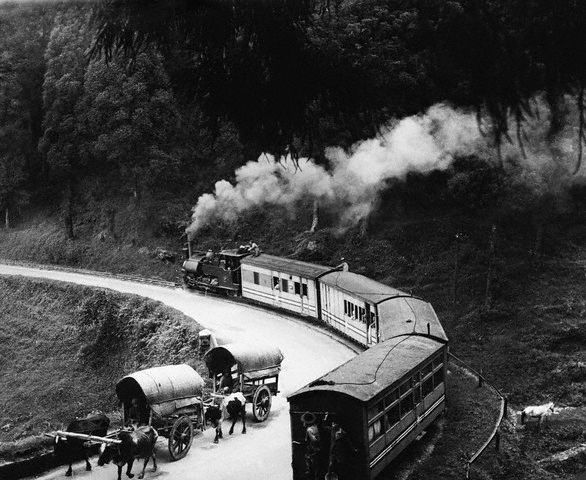
Company rule brought railways, telegraphs, and a unified administration — the first railway ran from Bombay to Thane in 1853 — but it also brought heavy land taxes, the ruin of Indian textile weavers as cheap British cloth flooded in, and famines that the Company's policies made worse. Indian soldiers, the sepoys who made up most of the Company's army, were paid less than British soldiers and denied promotion. Resentment grew for decades, and in 1857 it exploded into revolt.
From Company to Crown
After the revolt was crushed, the British government ended the experiment. The Government of India Act of 2 August 1858 transferred the Company's territories to the Crown: the Company armies were absorbed into the British Army, its navy was disbanded, and a Secretary of State for India in London and a Viceroy in India took charge. Parliament formally dissolved the Company in 1874. The British Raj — direct Crown rule — had begun, and it would last until 1947. Queen Victoria was proclaimed Empress of India at the Delhi Durbar on 1 January 1877.
| Year | Event |
|---|---|
| 1600 | East India Company chartered |
| 1608 | First Company ships reach Surat |
| 1757 | Battle of Plassey; Bengal under Company control |
| 1765 | Diwani of Bengal, Bihar, and Orissa granted |
| 1853 | First railway: Bombay to Thane |
| 1858 | Crown takes over; the Raj begins |
| 1874 | East India Company formally dissolved |
Sources: Wikipedia, "East India Company"; World History Encyclopedia, "East India Company"; Encyclopaedia Britannica, "East India Company"; New World Encyclopedia, "British Raj" Checked 27 November 2026.