The Indus Valley Civilisation: India's First Cities
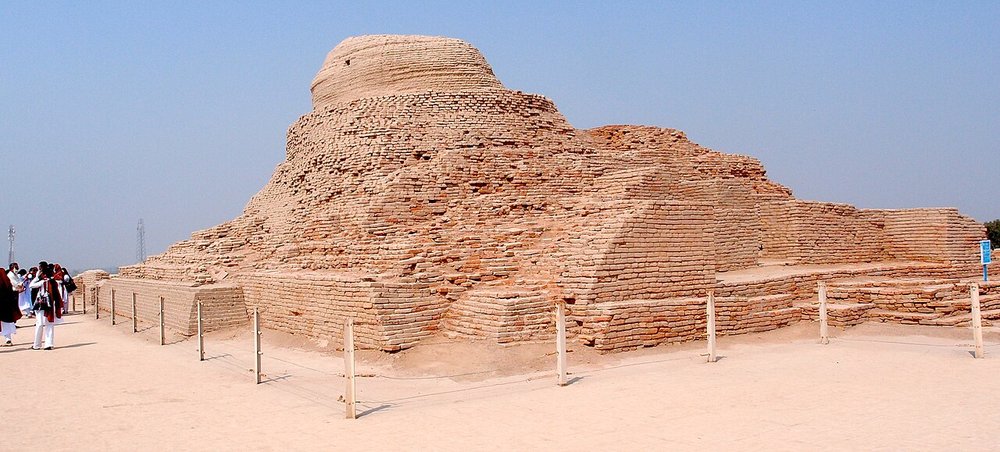
About 4,500 years ago, while the pyramids were rising in Egypt, cities were rising on the plains of the Indus River. They were not built around palaces or temples, as cities usually were, but around wells, drains, and orderly streets. The Indus Valley Civilisation — also called the Harappan Civilisation — was one of the world's first urban civilisations, and in area it was larger than ancient Egypt and Mesopotamia combined. Yet we still cannot read its writing, and we still do not know the names of its rulers, or whether it even had kings.
In short
In its mature phase, from about 2600 to 1900 BCE, the Indus Valley Civilisation built planned cities with grid streets, covered drains, and standardised bricks across what is now Pakistan and north-west India. Its script remains undeciphered, so almost everything we know comes from archaeology, not from written records.
A civilisation the size of a continent
The Indus Valley Civilisation flourished in the alluvial plains of the Indus River and its tributaries, and along rivers that once flowed through what is now the Ghaggar-Hakra region of north-west India and eastern Pakistan. At its height it covered more ground than ancient Egypt and Mesopotamia put together. More than a thousand of its sites have been reported, and nearly a hundred have been excavated. Only five were great urban centres: Harappa, Mohenjo-daro, Ganweriwala, Dholavira, and Rakhigarhi.
Harappa was the first site to be excavated, in 1921, by Daya Ram Sahni; Mohenjo-daro followed in 1922, excavated by R. D. Banerji. Both lie in what is now Pakistan. The civilisation is named after Harappa, its "type site" — the first place where it was recognised. Mohenjo-daro, in Sindh, became a UNESCO World Heritage Site in 1980, the first in South Asia. The cities were large: Mohenjo-daro and Harappa probably held between 30,000 and 60,000 people each, and the whole civilisation may have contained between one and five million people.
Streets, drains, and the Great Bath
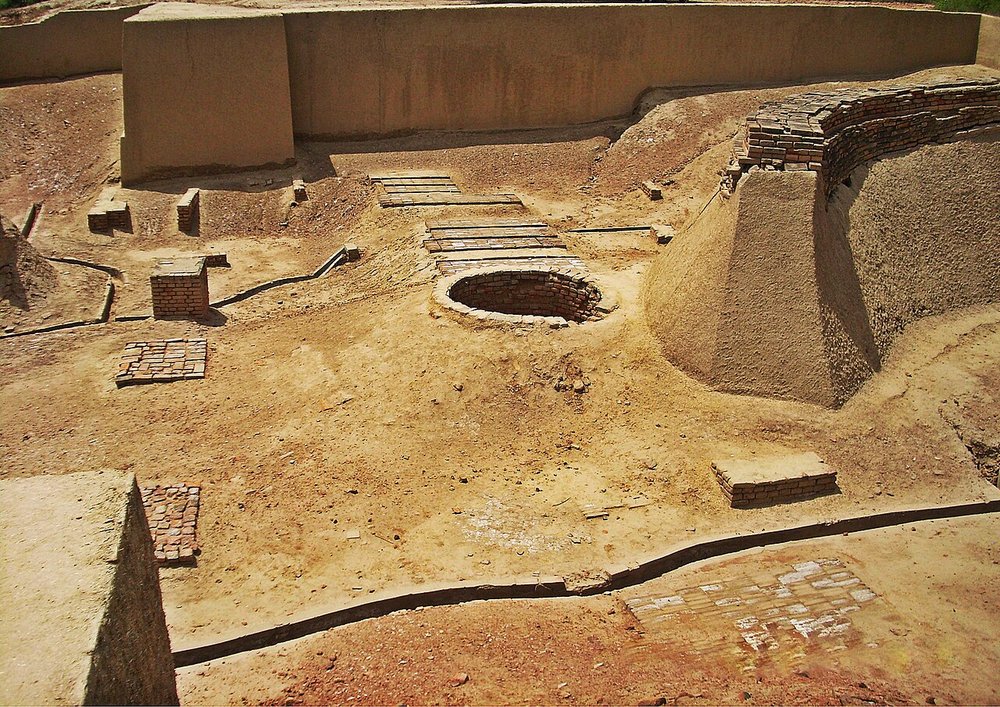
What strikes visitors to the ruins first is the planning. Streets run in a grid, crossing at right angles and dividing each city into rectangular blocks. Houses were built of baked bricks made to a fixed ratio — four units long, two wide, one thick — an early example of standardisation that held across hundreds of settlements. Many houses had their own well, a bathing room, and a toilet, and their drains fed into covered street drains with manholes at intervals for cleaning. No other ancient civilisation matched this system of sanitation.
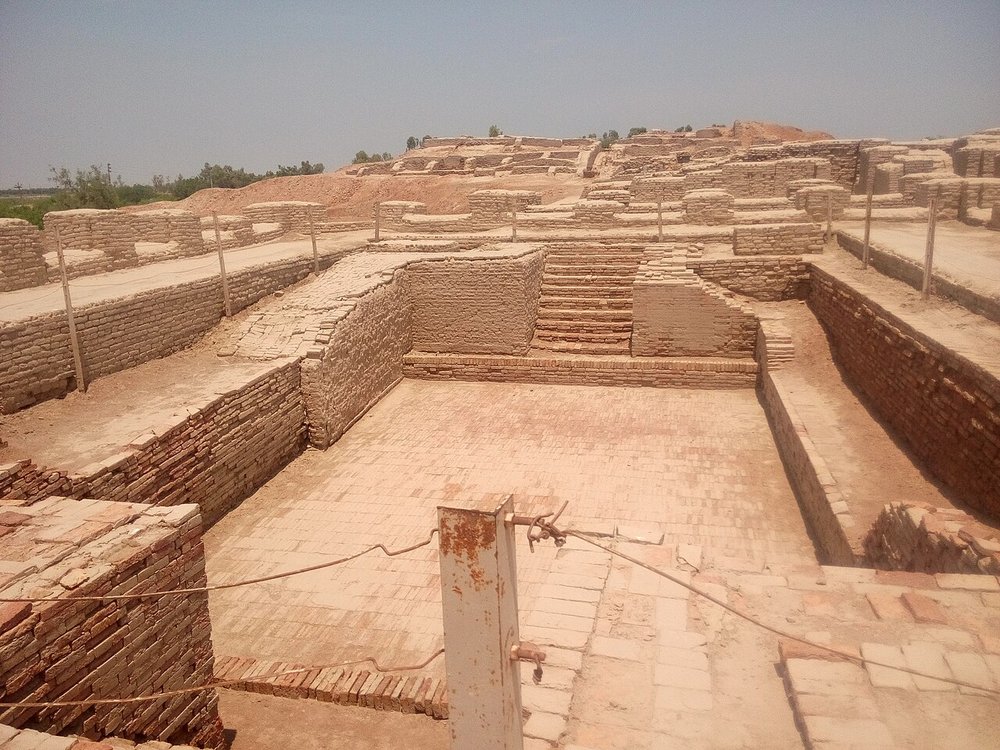
The most famous building at Mohenjo-daro is the Great Bath, a brick tank about twelve metres long and seven metres wide, with steps down at each end and small rooms around it. Its floor was sealed with a layer of natural tar to keep the water in, and it was probably used for ritual bathing. Nearby stood a large granary, and the city also produced seals — small carved stones, often showing animals and rows of signs — that were probably used to mark goods and ownership.
The writing nobody can read
The Indus people left behind a script of around 400 signs, found mostly on seals. It was written from right to left in one line and left to right in the next, a pattern called boustrophedon. But no one has ever deciphered it, and no long texts survive: the longest inscriptions are only a few dozen signs. The language behind it is not directly attested, and its family is uncertain — some scholars favour a link with the Dravidian languages, but that is a hypothesis, not a proven fact.
Because the script cannot be read, the civilisation is called proto-historic: we know it only through what it left in the ground. We do not know what its people called themselves, what gods they worshipped, or how they were ruled. There are no obvious royal palaces or grand royal tombs, which has led some archaeologists to suggest power may have been shared or organised differently from Egypt or Mesopotamia — but that, too, is an argument from absence, and it is still debated.
Trade, craft, and the end of the cities
The Harappans were skilled makers. They worked bronze and copper, carved beads from carnelian and lapis lazuli, made fine pottery, and built boats. Their seals and beads have been found as far away as Mesopotamia, showing that their goods travelled along long-distance trade routes. Standardised weights — small, carefully cut cubes of chert — have been found across the whole civilisation, another sign of an organised trading world.
By about 1900 BCE the cities began to shrink. People moved east, settlements became smaller, and by about 1300 BCE the great cities were abandoned. No single cause is accepted. A gradual drying of the region in the third millennium BCE may have reduced the water supply and pushed people away from the rivers; earthquakes, shifting river courses, and changes in trade may all have played a part. There is no good evidence for a sudden invasion destroying the cities. The people did not vanish — their crafts, farming, and settlements continued in smaller towns and villages, and many of the ways of life that grew up in the Indus cities carried on into later Indian history.
| Site | Where it is today | Famous for |
|---|---|---|
| Harappa | Punjab, Pakistan | First excavated (1921); rows of granaries |
| Mohenjo-daro | Sindh, Pakistan | The Great Bath; UNESCO site since 1980 |
| Dholavira | Gujarat, India | Large reservoirs and a signboard of Indus signs |
| Rakhigarhi | Haryana, India | One of the largest Harappan sites |
| Lothal | Gujarat, India | A dockyard and bead-making workshops |
Sources: Wikipedia, "Indus Valley Civilisation"; UNESCO, "Archaeological Ruins at Moenjodaro"; Encyclopaedia Britannica, "Indus civilization"; Smithsonian Magazine, "The Indus Valley Civilization" Checked 27 November 2026.